
Graphene Coating vs Ceramic Coating - What is the Difference and Which Should You Choose?

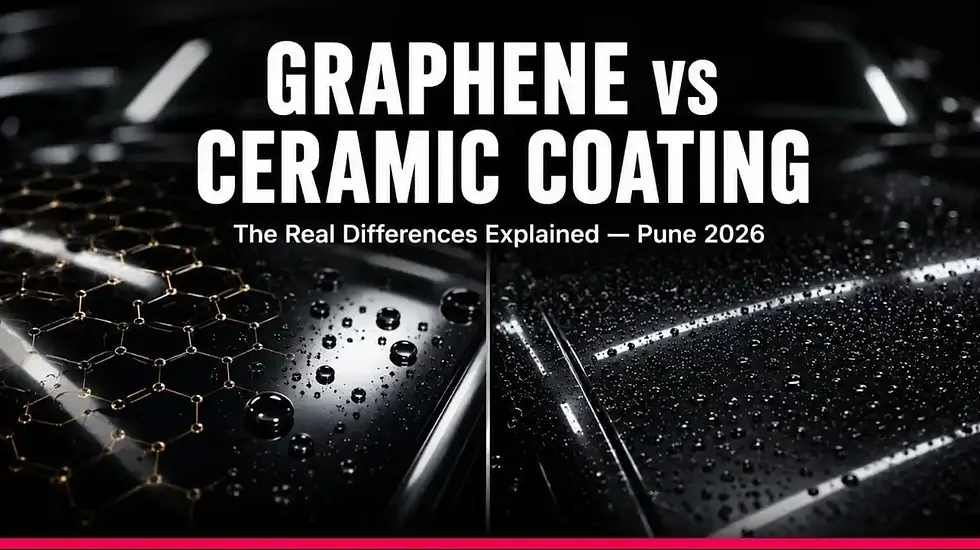
Graphene coating has become the most talked-about upgrade in professional car protection over the last two years. Every detailing studio that offers it markets it as the next generation beyond ceramic coating. Most of the marketing is accurate - graphene coatings do outperform standard ceramic coatings on several measurable parameters. But the differences matter more for some cars and some situations than others.
This post explains exactly what graphene coating is, how it differs from standard ceramic coating chemically and in practice, what the performance differences actually are, and whether the additional cost is justified for your specific car and how you use it in Pune.
What is Standard Ceramic Coating - A Quick Recap
Standard ceramic coating is a liquid polymer based primarily on silicon dioxide (SiO2). When applied to a car's clear coat, it bonds chemically and forms a hard, transparent protective layer. The SiO2 matrix gives the coating its characteristic properties: hydrophobicity (water beading), UV resistance, chemical resistance, and surface hardness.
Standard ceramic coatings from quality brands like 3M and Gyeon last 2 to 5 years depending on the product tier and maintenance. They are the most widely used professional paint protection product available and the baseline against which graphene coating is compared.
For a full explanation of ceramic coating, read our dedicated guide.
What is Graphene Coating?
Graphene coating is a ceramic coating formulation that incorporates graphene oxide (GO) into the silicon dioxide base. Graphene is a single-atom-thick layer of carbon atoms arranged in a hexagonal lattice. It is the strongest material known to science by weight, has exceptional electrical conductivity, and has unique thermal properties that make it useful in a coating context.
In a graphene ceramic coating, the graphene oxide particles are dispersed through the SiO2 matrix. The graphene does not replace the ceramic coating chemistry - it enhances it. The result is a coating that retains all the properties of standard ceramic coating and adds specific improvements from the graphene component.
Graphene coating is not a completely different product category from ceramic coating. It is an evolution of ceramic coating technology. The application process is the same. The preparation requirements are the same. The maintenance is the same. The difference is in the performance parameters of the cured coating.
The Real Differences Between Graphene and Standard Ceramic Coating
Hardness
Standard ceramic coatings are typically rated at 9H on the pencil hardness scale. Graphene ceramic coatings achieve 10H or equivalent — the maximum on the scale. In practical terms this means graphene-coated surfaces resist light abrasion and swirl marks slightly better than standard ceramic-coated surfaces. The difference is measurable but not dramatic for typical daily driving conditions.
Heat Dissipation
This is one of the most meaningful differences for Indian conditions. Graphene has exceptional thermal conductivity - it dissipates heat faster than silicon dioxide alone. A graphene-coated car bonnet exposed to Pune's summer sun heats up to a slightly lower peak temperature and cools faster when the sun moves. This matters because heat accelerates the degradation of any coating. A graphene coating on a car parked outdoors in Pune's March to June summer experiences less thermal stress than the same car with standard ceramic coating.
Water Spot Resistance
Water spots form when water evaporates on a surface and leaves behind mineral deposits. The more hydrophobic the surface, the faster water beads and rolls off before it can evaporate. Graphene coatings have stronger hydrophobic performance than standard SiO2 ceramic coatings — water beads tighter and rolls off faster. In Pune's hard water conditions, where water spot formation is a constant problem for cars parked outdoors, this difference is practically relevant.
This is the performance parameter where graphene coating delivers the most noticeable real-world benefit over standard ceramic coating in Pune specifically.
Anti-Static Properties
Graphene's electrical conductivity gives graphene-coated surfaces mild anti-static properties. Dust particles that carry a static charge are less attracted to graphene-coated surfaces than to standard ceramic-coated or bare paint surfaces. In Pune's construction dust conditions, this means graphene-coated cars accumulate dust slightly more slowly than standard ceramic-coated cars.
Longevity
Graphene coatings last longer than equivalent-tier standard ceramic coatings. A quality graphene coating typically carries a 5 to 7 year warranty where a comparable standard ceramic coating might carry a 3 to 5 year warranty. The graphene oxide in the matrix improves the coating's resistance to degradation over time. For car owners who plan to keep their vehicle for 5 or more years, this difference in longevity is meaningful.
Gloss
Both graphene and standard ceramic coatings significantly enhance paint gloss. The difference between them in terms of initial gloss enhancement is minimal. Where graphene has an advantage is gloss retention over time - the coating maintains its gloss better as it ages compared to standard ceramic.
Where Graphene and Standard Ceramic Coating Are the Same
Stone chip protection: Neither product protects against stone chips. A graphene coating is not a physical barrier. Stone chip protection requires PPF regardless of which coating is on the car.
Application process: Graphene coating is applied the same way as standard ceramic coating — panel by panel after thorough preparation including decontamination, clay bar, and paint correction. The preparation requirements are identical. A graphene coating applied over uncorrected paint performs no better than standard ceramic in the same situation.
Maintenance requirements: pH-neutral shampoo, no rotating brush car washes, prompt removal of bird droppings and tree sap, annual maintenance inspection. The maintenance routine is the same for both products.
What they protect against: UV resistance, chemical resistance, hydrophobic performance, and gloss enhancement - both products provide all of these. Graphene provides them at a higher level, but the category of protection is the same.
Disadvantages of Graphene Coating - The Honest Assessment
Graphene coating is better than standard ceramic coating on measurable parameters. But it has real disadvantages that the marketing rarely mentions.
Higher cost for marginal gains in some situations. For a car that is garaged overnight, driven mostly in the city, and washed regularly, the real-world performance difference between graphene and quality standard ceramic from 3M or Gyeon is difficult to notice in daily use. The heat dissipation advantage matters most for cars parked in full sun all day. The anti-static advantage matters most in high-dust environments. For a car that avoids both these conditions, graphene's premium is harder to justify.
Same preparation requirements. Graphene does not compensate for inadequate preparation. Studios that charge graphene prices and skip paint correction, clay bar, or decontamination produce inferior results despite the premium product. The preparation is where most of the quality difference between studios comes from - not the coating tier.
Does not protect against stone chips. Despite being the hardest coating available, graphene does not stop stone chips. This is the most common misconception. The 10H hardness rating is a pencil hardness scale measurement, not impact resistance. For stone chip protection, PPF is the only effective solution regardless of which coating is on the car.
No meaningful benefit on already-protected cars. If your car has PPF on the high-impact panels and is garaged, the practical benefit of graphene over standard ceramic for the remaining panels is minimal. Standard ceramic coating on the full car plus PPF on the front end is often better value than graphene coating alone.
Graphene vs Ceramic Coating - Performance Comparison
Parameter | Standard Ceramic | Graphene Ceramic | Winner |
Hardness | 9H | 10H | Graphene |
Heat dissipation | Good | Excellent | Graphene |
Water spot resistance | Good | Excellent | Graphene |
Anti-static properties | None | Mild | Graphene |
Initial gloss | Excellent | Excellent | Equal |
Gloss retention | Good | Excellent | Graphene |
UV resistance | Excellent | Excellent | Equal |
Chemical resistance | Excellent | Excellent | Equal |
Stone chip protection | None | None | Equal (neither) |
Warranty period | 2 to 5 years | 5 to 7 years | Graphene |
Application process | Standard | Standard | Equal |
Maintenance | Standard | Standard | Equal |
Cost | Lower | Higher | Ceramic |
Who Should Choose Graphene Coating?
Graphene coating makes most sense in specific situations. Not every car owner needs it over standard ceramic.
Cars parked outdoors in Pune's summer: The heat dissipation advantage is most relevant for cars that sit in direct sun during Pune's March to June heat. A car parked in a covered garage most of the time benefits less from graphene's thermal properties than one parked on an open road.
Long-term ownership: If you plan to keep the car for 5 or more years, the longer warranty period and better longevity of graphene coating justify the additional cost. Over a 7-year ownership period, one graphene coating may outlast two applications of standard ceramic coating.
Hard water sensitivity: In areas of Pune with particularly problematic hard water -Wagholi, Hadapsar, and areas dependent on overhead tank water - graphene's stronger water spot resistance is a practical advantage.
Luxury vehicles: The additional performance of graphene coating on a car where paint repair is expensive makes the cost premium proportionally smaller. For a BMW or Mercedes owner, the difference in cost between standard ceramic and graphene coating is minor relative to the overall value of the vehicle and the cost of paint correction if the coating degrades prematurely.
Dusty environments: Cars in areas with high construction dust exposure — which is most of Pune given ongoing city development - benefit from graphene's mild anti-static properties that reduce dust accumulation between washes.
Who Should Choose Standard Ceramic Coating?
Standard ceramic coating from quality brands like 3M and Gyeon remains an excellent product that delivers significant and measurable benefits. It is the right choice for most car owners.
Budget-conscious owners who still want quality: Standard ceramic coating from 3M or Gyeon delivers genuine UV protection, strong hydrophobic performance, and chemical resistance at a lower cost than graphene. For everyday cars where the owner wants meaningful paint protection without the top-tier price, quality standard ceramic coating is the right answer.
Shorter ownership periods: If you plan to sell the car within 3 years, a standard ceramic coating with a 3-year warranty matches your ownership period. Paying for a 7-year graphene coating on a car you plan to sell in 2 years does not make financial sense.
Cars garaged overnight: A car that spends nights in a garage and is not exposed to full-day direct sun loses some of the practical benefit of graphene's heat dissipation advantage. Standard ceramic coating delivers excellent results for this usage pattern.
Mid-segment cars: For a Hyundai Creta, Kia Seltos, or Maruti Swift owner who wants their car protected and looking good, quality standard ceramic coating from 3M or Gyeon delivers results that are hard to distinguish from graphene in everyday use. The performance gap is more relevant at the premium end.
The Smart Combination - PPF on High-Risk Panels and Graphene Coating on the Full Car
The question of graphene vs ceramic coating often misses the most practical answer for serious car owners: use both products together, each where it performs best.
PPF on high-impact areas: Bonnet, front bumper, front fenders, headlights, mirrors, and door edges. These panels take stone chip damage, deep scratches, and road debris impact that neither ceramic nor graphene coating can stop. PPF is the only product that physically absorbs this damage.
Graphene coating over the full car including over the PPF: The graphene coating goes on top of the PPF on protected panels and directly on the paint on the rest of the car. This gives the PPF panels ceramic protection on top - easier to clean, better gloss, UV resistance — and gives the unprotected panels graphene's superior hydrophobic and heat-resistant properties.
This combination costs more than either product alone but delivers protection that neither product delivers individually. For a new luxury vehicle or a car being kept for 7 or more years, this is the most comprehensive protection available.
At Carbon and Chrome we do this combination regularly. The sequencing is: PPF installation first, cure time, then graphene coating application over the full car.
Cost Difference Between Graphene and Standard Ceramic Coating in Pune
Graphene coating costs more than standard ceramic coating. The difference varies by studio, brand, and car size but typically ranges from 20 to 40 percent more for an equivalent protection tier.
At Carbon and Chrome, the right product for your car depends on your specific situation. We recommend graphene coating where the performance advantages are practically relevant and standard ceramic coating where they are not — rather than recommending graphene for every job because it is more expensive.
For a specific cost comparison for your car, WhatsApp us with your car model. We give a quote for both options so you can make an informed decision.
Graphene Coating in Pune - The Preparation Still Determines the Result
The biggest misconception about graphene coating is that its superior chemistry compensates for inferior preparation. It does not.
A graphene coating applied over swirl marks, water spots, or contamination locks those defects in just as permanently as standard ceramic coating. The graphene matrix is no more forgiving of preparation shortcuts than SiO2. The preparation process - decontamination, clay bar, paint correction, panel wipe-down - is identical and equally non-negotiable for both products.
Studios that market graphene coating as a premium product and then skip preparation steps are charging premium prices for inferior results. At Carbon and Chrome, every coating job - graphene or standard ceramic - goes through the same thorough preparation process. The coating tier determines the product going on the paint. The preparation determines how long it lasts and how good it looks.
Graphene vs Ceramic Coating - Does Your Car's Colour Matter?
White and silver cars: White and light-coloured cars show dust accumulation more visibly than dark cars. Graphene's mild anti-static properties reduce how quickly dust bonds to the surface - a practical advantage for white and silver car owners in Pune's construction dust conditions. The anti-static effect is not dramatic but over weeks between washes, the difference is noticeable.
Dark cars (black, dark blue, dark grey): Dark cars show swirl marks and water spots more visibly than light colours. Graphene's stronger water spot resistance and slightly better swirl resistance are more visibly relevant on dark-coloured cars. Gloss retention on dark cars also shows the difference between graphene and standard ceramic more clearly over time.
Red, orange, and bright colours: The colour itself does not change which coating performs better. The relevant factors remain the same - how the car is parked, how long it will be kept, and what the primary concern is.
Graphene and Ceramic Coating at Carbon and Chrome, Viman Nagar
Carbon and Chrome is a certified applicator for 3M and Gyeon ceramic and graphene coating products. We offer both standard ceramic coating and graphene ceramic coating tiers at our Viman Nagar studio.
Every coating job starts with a paint inspection. We discuss your car's condition, how you use it, how long you plan to keep it, and where it is parked. Based on that conversation we recommend the right product - standard ceramic or graphene - for your specific situation.
Open till 8 PM every day. Located in Ramwadi, Viman Nagar, near Novotel, next to Hyperion Superbikes, Pune.
Customers come from Kharadi (4 km), Kalyani Nagar (3 km), Koregaon Park (5 km), Yerwada (2 km), Wagholi (7 km), Hadapsar (8 km), and across Pune.
After Graphene Coating is Applied - What to Do in the First Week
The coating cures in stages. Initial cure takes 24 to 48 hours. Full hardness develops over 2 to 4 weeks.
First 24 to 48 hours: Do not wash the car. Do not expose it to heavy rain. Park in a covered area if possible. Avoid bird droppings landing on the surface during this period — if they do, remove them gently with a damp microfibre rather than letting them sit.
First wash: Wait at least 7 days before the first wash after graphene coating. Use pH-neutral shampoo and hand wash only. No automatic car washes for at least 30 days.
First 30 days: Avoid harsh chemicals, automatic car washes, and waxing or applying any additional products over the coating. The coating is still developing its full hardness during this period.
After 30 days: Normal maintenance routine - pH-neutral shampoo washes every 2 weeks, no rotating brush car washes, annual maintenance inspection.
We walk you through this routine when you collect the car from our studio. Most coating performance issues arise from incorrect post-application care in the first 30 days, not from the coating product itself.
Frequently Asked Questions
What is the difference between graphene coating and ceramic coating?
Both are professional paint protection coatings. Standard ceramic coating uses silicon dioxide (SiO2) as the primary compound. Graphene coating adds graphene oxide to the SiO2 matrix. The result is a coating that is harder, dissipates heat better, resists water spots more effectively, has mild anti-static properties, and lasts longer than standard ceramic coating. The application process and maintenance requirements are the same for both.
Is graphene coating worth it over ceramic coating?
Depends on your situation. Graphene coating is worth the additional cost for cars parked outdoors in Pune's summer heat, long-term ownership plans of 5 or more years, luxury vehicles, and cars in high construction dust areas. For everyday cars with shorter ownership plans, quality standard ceramic coating from 3M or Gyeon delivers excellent results at lower cost.
Does graphene coating prevent scratches?
Neither graphene nor standard ceramic coating prevents deep scratches or stone chips. Graphene coating adds 10H hardness which resists light swirl marks from washing slightly better than 9H standard ceramic. For physical protection against stone chips and deep scratches, PPF is the right product.
How long does graphene coating last?
Quality graphene ceramic coatings typically carry 5 to 7 year warranties. Standard ceramic coatings carry 2 to 5 year warranties depending on the tier. Graphene's longer lifespan comes from improved resistance to thermal degradation and better chemical resistance over time.
Is graphene coating better for Pune's climate?
Yes, particularly for cars parked outdoors. Pune's summer heat (March to June) and hard water conditions are where graphene's advantages are most relevant. The heat dissipation property reduces thermal stress on the coating during peak summer. The stronger hydrophobic performance reduces hard water spot formation year-round. For cars parked in the sun daily in Pune, graphene coating is the better long-term choice.
What brands of graphene coating do you use at Carbon and Chrome?
We use 3M and Gyeon graphene ceramic coating products. Both brands offer graphene tiers within their professional coating ranges. We are certified applicators for both brands.
Is the preparation process different for graphene coating?
No. The preparation is identical to standard ceramic coating - decontamination wash, clay bar, paint correction, panel wipe-down with IPA. The preparation requirements are the same because graphene coating bonds to the clear coat the same way standard ceramic does and is equally unforgiving of preparation shortcuts.
How much more does graphene coating cost than ceramic coating?
Typically 20 to 40 percent more for an equivalent coverage tier depending on the car size and brand. WhatsApp us on 8484092049 with your car model for a specific comparison quote for standard ceramic vs graphene on your car.
Can graphene coating be applied over existing ceramic coating?
No. Graphene coating bonds to the clear coat, not to an existing coating. If your current ceramic coating is still intact and performing well, apply a ceramic booster rather than a full graphene recoat. When the existing coating has worn off, a full preparation and graphene coating application can be done.
How do I book a graphene coating appointment in Pune?
WhatsApp us on 8484092049 with your car model. We discuss your situation, inspect the paint, and recommend the right product - graphene or standard ceramic - before any work begins. Our studio is in Ramwadi, Viman Nagar, open till 8 PM every day.


